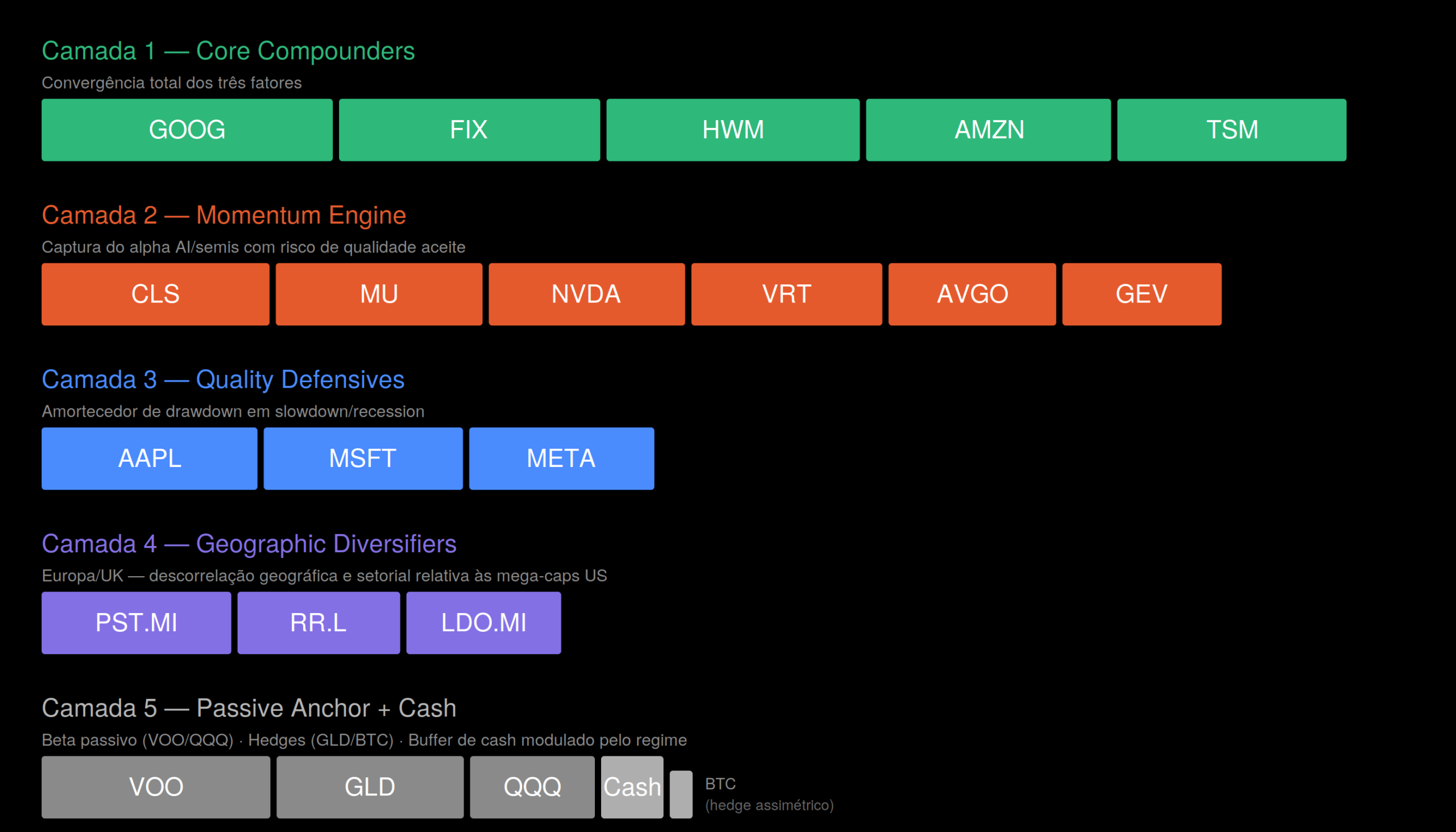
The elegance of a strong portfolio architecture becomes clear when we can explain 20+ positions in a simple and structured way.
At Santiago1000, I do not see the portfolio as a random collection of stocks. I see it as a layered system, where each asset has a specific function within the broader economic cycle.
Today, the portfolio can be read through 5 main layers:
1. Core Compounders
This is the structural layer. These are the “always own” positions, as long as they continue to deliver quality, scale, cash flow, competitive leadership and sustainable growth.
Here we find names like $GOOG, $MSFT, $AMZN, $META, $AAPL, $AVGO and $TSM.
This layer moves very little. It is the long-term heart of the portfolio.
2. Momentum Engine
This is the offensive layer. It captures alpha from AI, semiconductors, digital infrastructure and earnings momentum.
Examples: $MU, $NVDA, $VRT, $FIX and $CLS.
It is also the layer that moves the most. In Expansion, it can rise above 30%. In Recession, it should contract below 20%.
3. Quality Defensives
This layer adds resilience. It helps reduce drawdown risk when the cycle becomes more uncertain, volatility rises, or the market starts to punish high-beta assets.
Positions here include $JPM, $IBE.MC, $GLD and part of the more resilient exposure.
When the Momentum Engine contracts, this layer tends to expand.
4. Geographic Diversifiers
Not everything should depend on the US market or on one single narrative. This layer adds geographic, sector and currency diversification, especially through European and UK exposure.
Names here include $RR.L, $LDO.MI, $PST.MI, $IBE.MC and other European assets linked to industry, defense, energy, essential services and infrastructure.
Its role is to reduce concentration and capture opportunities beyond US mega-cap technology.
5. Passive Anchor + Cash
This is the stabilising layer. It includes passive beta, hedges and a cash buffer.
$VOO and $QQQ provide broad market exposure.
$GLD works as a portfolio diversifier.
Cash gives tactical flexibility.
$BTC remains a small asymmetric hedge.
The key idea is simple:
The portfolio has 5 functions, not just a list of tickers.
Core Compounders provide structure.
Momentum Engine drives acceleration.
Quality Defensives add resilience.
Geographic Diversifiers reduce concentration.
Passive Anchor + Cash provides balance and flexibility.
This also makes risk management easier to understand.
In Expansion, the Momentum Engine can grow.
In Recovery, growth leaders gradually gain weight.
In Slowdown, defensives expand and momentum contracts.
In Recession, the priority becomes capital preservation, quality and flexibility.
For me, a good portfolio is not only about choosing strong companies. It is about understanding what role each position plays inside the system.
That is how I aim to manage Santiago1000: with conviction, architecture, discipline and awareness of the economic cycle.
Not financial advice.
Acompanha a carteira em tempo real
Todas as posições e pesos do modelo estão visíveis no meu perfil público na eToro.
Ver o perfil @Santiago1000 →Link de afiliado: se abrires conta através dele, posso receber uma comissão da eToro, sem custo para ti. Não é recomendação de investimento. O teu capital está em risco.Follow the portfolio in real time
Every position and weight in the model is visible on my public eToro profile.
View the @Santiago1000 profile →Affiliate link: if you open an account through it, I may receive a commission from eToro at no cost to you. Not investment advice. Your capital is at risk.Segui il portafoglio in tempo reale
Tutte le posizioni e i pesi del modello sono visibili sul mio profilo pubblico eToro.
Vedi il profilo @Santiago1000 →Link di affiliazione: se apri un conto tramite questo link, potrei ricevere una commissione da eToro, senza costi per te. Non è una raccomandazione di investimento. Il tuo capitale è a rischio.
