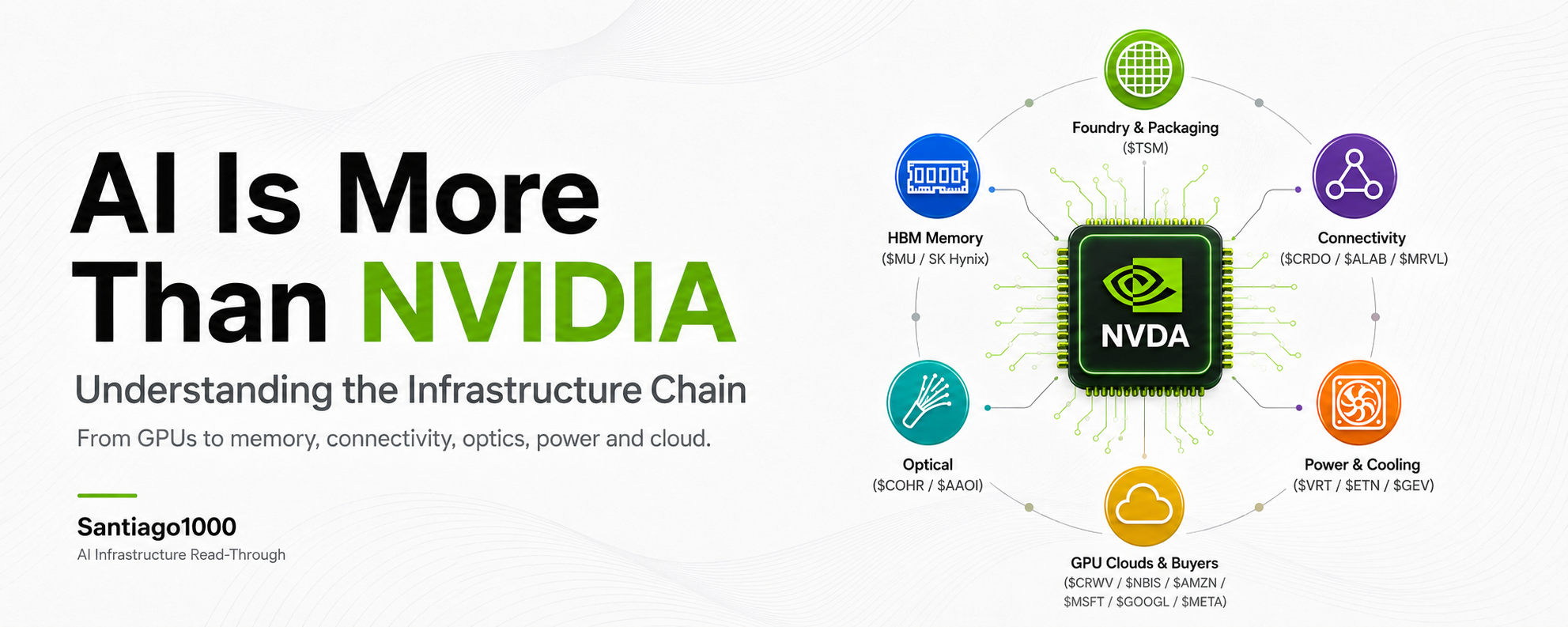
NVIDIA has become the leading symbol of the Artificial Intelligence revolution. But looking at AI only through NVIDIA means seeing just the first layer of a much bigger transformation.
Every new GPU put into operation requires memory, connectivity, fiber optics, power, cooling, advanced manufacturing and enormous data centers. In other words, NVIDIA’s growth creates economic effects across an entire AI infrastructure chain.
For investors, understanding the AI infrastructure chain can be just as important as identifying who makes the best chip.
Think of the GPU as the engine of the AI infrastructure chain
A simple way to understand the ecosystem is to picture a car. The GPU is the engine. It can be extraordinarily powerful, but on its own it doesn’t make the car run. You need fuel, a transmission, an electrical system, cooling, tires, and a whole infrastructure built around it.
The same happens with AI. The more GPUs get installed, the more infrastructure needs to exist to make them run efficiently. That’s where many of the potential beneficiaries of the current AI investment cycle come from.
1. Foundry and Advanced Packaging — $TSM
Before an NVIDIA GPU reaches a data center, it has to be manufactured. TSMC holds a central position in this chain, producing some of the world’s most advanced chips and offering the packaging technologies essential to integrate processors and memory.
As chips get bigger, more complex and more powerful, manufacturing capacity and advanced packaging become strategic bottlenecks. That’s why AI’s growth doesn’t only benefit chip designers — it also raises the economic importance of the companies able to actually build them.
2. HBM — $MU and SK Hynix
An extremely fast GPU is of little use if it can’t receive data quickly enough. That’s exactly where HBM — High Bandwidth Memory — comes in. This type of memory was built to move huge amounts of data rapidly between memory and processors.
Increasingly large models and clusters with thousands of GPUs raise the need for HBM. That’s why companies like Micron and SK Hynix have become strategic components of AI infrastructure. The logic is simple: more compute → more need for high-speed memory.
3. Connectivity — $CRDO, $ALAB and $MRVL
This is perhaps one of the least understood parts of AI. A large data center doesn’t function like thousands of independent GPUs. Those processors need to communicate with each other continuously and with extremely low latency.
As clusters grow from thousands to tens or hundreds of thousands of accelerators, moving data between them becomes an increasingly bigger challenge. This is exactly the layer where companies like Credo Technology $CRDO, Astera Labs $ALAB and Marvell $MRVL can benefit.
And here there’s an important distinction. A company doesn’t necessarily need to be a major direct supplier to NVIDIA to benefit from NVIDIA’s growth. Credo, for example, can gain from something even broader: the need to connect increasingly larger AI clusters. If the number of GPUs grows, the number of high-speed connections required tends to grow too.
4. Optical Networking — $COHR and $AAOI
As data centers keep growing in size, moving enormous volumes of information using only electrical connections becomes progressively harder. Fiber optics then take on a growing role.
More AI compute requires more bandwidth. More bandwidth can require more optical components, transceivers and fiber communication systems. That’s why companies like Coherent $COHR and Applied Optoelectronics $AAOI are part of our read of the ecosystem.
5. Power & Cooling — $VRT, $ETN and $GEV
Perhaps AI’s biggest structural bottleneck isn’t even a semiconductor. It might be power. AI data centers consume extraordinary amounts of electricity and generate enormous amounts of heat. As a result, every new expansion of compute capacity also requires:
- power distribution;
- power delivery systems;
- cooling;
- data center equipment;
- additional generation capacity;
- grid modernization.
That’s why companies like Vertiv $VRT, Eaton $ETN and GE Vernova $GEV have become part of the AI infrastructure conversation. The relationship can be summed up like this: more GPUs → more power → more cooling → more infrastructure.
6. GPU Clouds and Hyperscalers
At the other end of the chain are those who actually buy and operate enormous quantities of GPUs. Among them are the hyperscalers — $AMZN, $MSFT, $GOOGL and $META — and companies specialized in GPU cloud, such as $CRWV and $NBIS.
These companies’ investments matter in particular because they represent the final demand for infrastructure. When Big Tech raises capex to build data centers, that capital starts circulating through practically the entire chain we’ve just walked through.
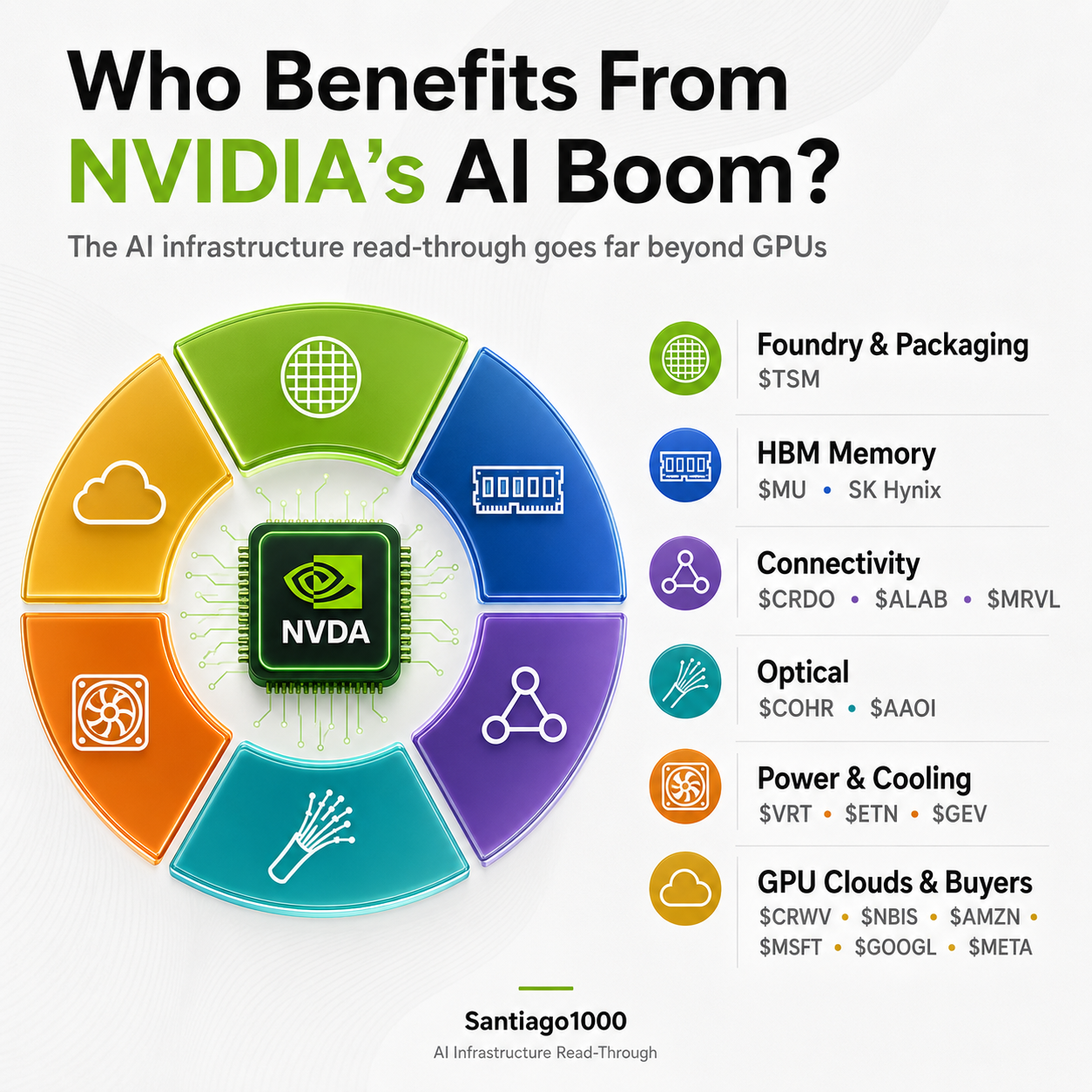
NVIDIA earnings are about a lot more than NVIDIA earnings
That’s why I follow NVIDIA’s results not just to assess $NVDA. They also work as a kind of thermometer for the whole AI infrastructure chain. If demand for accelerated computing stays elevated, we can look for the effects of that growth across the chain:
Semiconductors → HBM → Connectivity → Optics → Power → Cooling → Cloud
That read helps identify companies that may benefit even before the full impact shows up in their own results.
Direct suppliers vs. indirect beneficiaries in the AI infrastructure chain
There’s also a fundamental distinction for any investor analyzing this market.
Some companies are first-order beneficiaries. They participate directly in manufacturing or supplying components used in NVIDIA systems.
Others are second-order beneficiaries. They benefit because deploying more GPUs requires more infrastructure around them.
That difference matters. We shouldn’t call every company linked to the AI ecosystem an “NVIDIA supplier.” But we can ask something more interesting: who benefits economically when millions of new GPUs need to be installed, connected, powered and cooled?
Where might the next opportunity be?
During the first phase of the AI boom, most of the market’s attention concentrated on the GPUs themselves. The next phase may be different.
As the amount of installed compute grows, the bottlenecks also start to shift. First, GPUs were scarce. Then pressure built up on HBM. Now connectivity, optical networking, power and cooling are becoming progressively more important.
That’s why one of the questions I consider most relevant for the coming years isn’t simply “Who will build the best AI chip?” but rather “Where will the next bottleneck appear as AI compute keeps growing?”
It’s precisely in those bottlenecks that some of the most interesting investment opportunities of the next stage of the cycle may emerge.
NVIDIA may well keep being the engine of the AI revolution. But the economic value created by that engine could spread across an AI infrastructure chain far larger than many investors still imagine.
This article represents exclusively my own opinion and is for educational purposes only. It does not constitute investment advice. All investing involves risk, and every investor should carry out their own analysis before making decisions.
Acompanha a carteira em tempo real
Todas as posições e pesos do modelo estão visíveis no meu perfil público na eToro.
Ver o perfil @Santiago1000 →Link de afiliado: se abrires conta através dele, posso receber uma comissão da eToro, sem custo para ti. Não é recomendação de investimento. O teu capital está em risco.Follow the portfolio in real time
Every position and weight in the model is visible on my public eToro profile.
View the @Santiago1000 profile →Affiliate link: if you open an account through it, I may receive a commission from eToro at no cost to you. Not investment advice. Your capital is at risk.Segui il portafoglio in tempo reale
Tutte le posizioni e i pesi del modello sono visibili sul mio profilo pubblico eToro.
Vedi il profilo @Santiago1000 →Link di affiliazione: se apri un conto tramite questo link, potrei ricevere una commissione da eToro, senza costi per te. Non è una raccomandazione di investimento. Il tuo capitale è a rischio.
