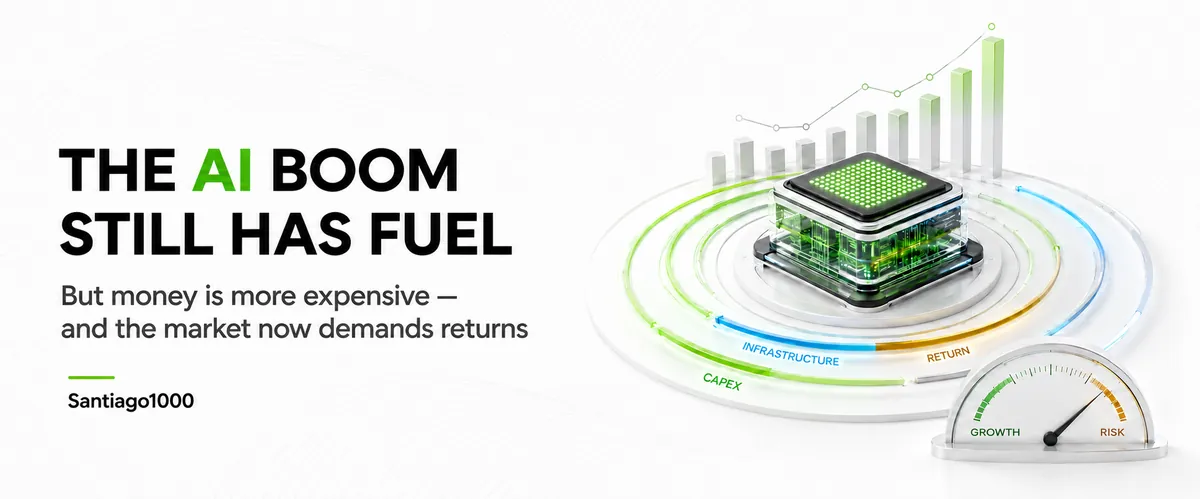
The market is once again asking the question that follows almost every major technological revolution: are we looking at a sustainable economic transformation, or at a bubble about to burst?
In the case of artificial intelligence, the most honest answer isn’t at either extreme. AI is real, demand for computing capacity is real, and revenues are starting to show up. At the same time, the scale of the investment has become so large that believing in the technology’s potential is no longer enough. Companies will have to prove they can turn hundreds of billions of dollars into revenue, cash flow and return on capital.
A recent Barron’s analysis, built on major investment cycles over the past 250 years, reaches an interesting conclusion: the current AI boom will probably see a correction at some point, but history suggests that moment hasn’t arrived yet.
An investment cycle without precedent
Since the beginning of 2024, an estimated $500 billion has gone into chips, $350 billion into electrical infrastructure, $200 billion into construction and $100 billion into networking. The main hyperscalers — Amazon, Microsoft, Alphabet and Meta — could invest roughly $2 trillion more over the next two years.
This helps explain why AI has stopped being a story that benefits only semiconductor makers. Every new data center requires land, construction, transformers, power generation and distribution, cooling, fiber optics, servers, memory, cables and networking equipment.
One Big Tech company’s capex becomes revenue for dozens of suppliers. That mechanism is what continues to support companies spread across the entire digital infrastructure chain.
What 250 years of history teach us
Large infrastructure cycles tend to follow a similar pattern. A transformative technology appears, capital starts flowing in, valuations rise, capacity is built quickly, and credit begins to finance a growing share of the investment. That is how it went with railroads, electrification, the internet and real estate.
The Barron’s analysis identifies a historical benchmark it calls the “25% rule”. In several of those cycles, the most serious problems appeared when cumulative investment approached 25% of the size of the economy.
With US GDP close to $30 trillion, that risk zone would correspond to roughly $7.5 trillion. On current projections, AI investment would only approach that level in the early 2030s.
I don’t treat that rule as an economic law. The mix of financing, the speed of technological obsolescence and the profitability of projects matter as much as the aggregate amount. Even so, the historical parallel helps explain why a gigantic level of investment doesn’t necessarily mean the cycle is close to its end.
The biggest risk isn’t the technology: it’s the cost of capital
While data centers were financed mainly out of Big Tech’s cash flow, the market had little reason to worry. Those companies had extremely strong balance sheets and enough capacity to absorb several years of investment.
Now, however, the cycle is becoming more dependent on debt, private credit, financial vehicles and vendor financing arrangements. That changes the nature of the risk.
If Treasury yields keep rising, the financing cost of these projects rises with them. A data center that looks highly profitable with cheap capital can stop being attractive when debt costs go up, construction is delayed, or equipment becomes obsolete faster than expected.
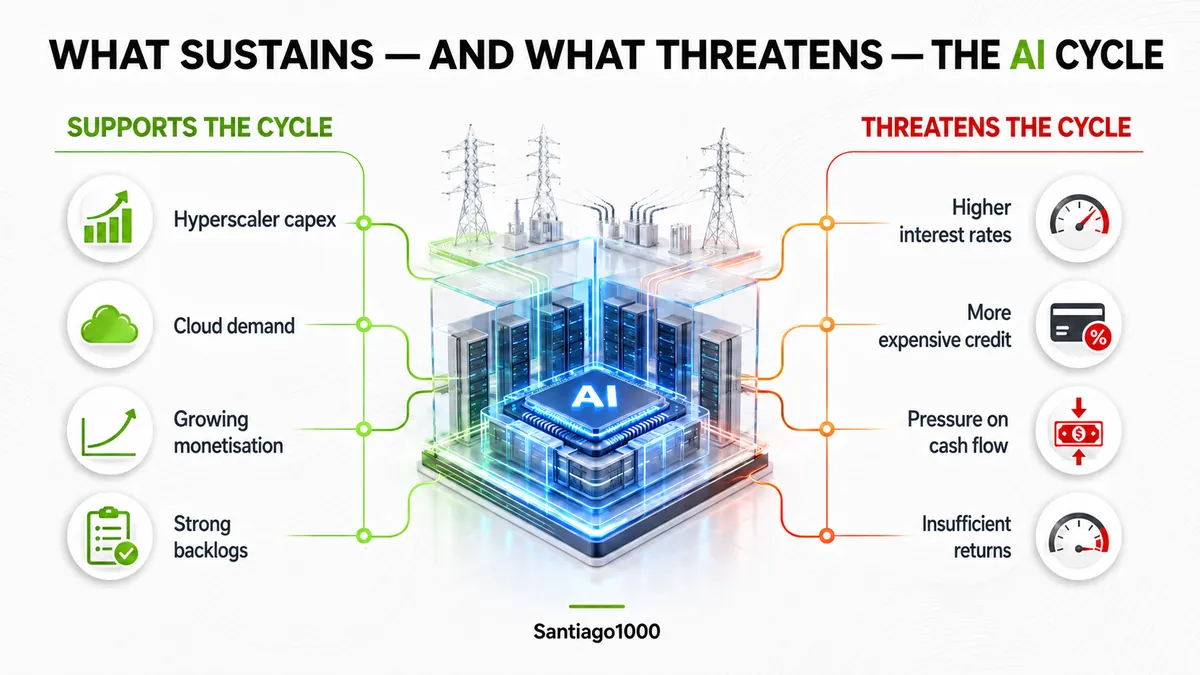
That’s why I believe the main trigger for an eventual correction won’t be a headline saying “AI doesn’t work”. It will more likely be a combination of:
- persistently high interest rates;
- rising leverage;
- weaker free cash flow generation;
- delays in construction and grid connections;
- AI revenues below what’s needed to remunerate the invested capital.
Monetization has started — but it will have to accelerate
The bullish case has become more solid because there are already concrete signs of monetization. Cloud demand keeps growing, models are being embedded into enterprise software, and inference consumption rises as the cost per use falls.
That last point matters. More efficient chips and models don’t necessarily mean less demand for computing capacity. When the cost of a technology falls, new applications appear, more users arrive and consumption volumes become far larger. That’s the Jevons paradox.
Still, the market will increasingly distinguish usage growth from profitable growth. A company can show more customers, more tokens processed and more installed capacity without generating an adequate return on that investment.
In the next phase of the cycle, announcing more capex will no longer be enough. Investors will want to understand how much of that investment converts into incremental revenue, margins and cash flow.
Who can keep benefiting
As long as capex keeps expanding, I continue to see opportunities along the whole chain:
- Compute and semiconductors: $NVDA, $TSM, $AVGO and $MU;
- Power and thermal management: $VRT and $GEV;
- Construction and electrical infrastructure: $FIX;
- Electronics manufacturing and systems integration: $CLS;
- Connectivity and fiber optics: $GLW.
That doesn’t mean all of these stocks are cheap or that they’ll rise in a straight line. An excellent company can be a poor investment when the valuation already assumes flawless execution. Selection has to combine structural growth, balance sheet quality, order visibility, margins and the price paid.
It’s also important to separate the suppliers from the buyers of infrastructure. In the short term, hyperscaler capex is revenue for the chain. For Amazon, Microsoft, Alphabet and Meta, though, it’s cash out the door and an obligation to generate future returns. The same dollar can be bullish for the supplier while temporarily pressuring the customer’s cash flow.
The five indicators I’m watching
To judge whether the cycle is still healthy, I find these signals more useful than simply asking whether there’s a bubble:
- Hyperscaler capex guidance: simultaneous cuts would be a meaningful warning.
- Cloud and AI revenue growth: it needs to gradually keep pace with the increase in capacity.
- Free cash flow: it shows how much of the investment already requires debt or alternative structures.
- 10-year Treasury and credit spreads: they measure the pressure from the cost of capital.
- Backlog, orders and cancellations: these reveal any weakening in the data center chain first.
None of these indicators on its own determines the end of the cycle. A joint deterioration, however, would significantly change the risk-reward balance.
Conclusion: there’s still room, but discipline will be decisive
My read is that AI infrastructure remains in a structural expansion cycle. Demand is still there, hyperscalers keep raising investment, and suppliers are showing real revenue and earnings growth. So I don’t see enough evidence to abandon the thesis simply because the absolute numbers look gigantic.
But the cycle is maturing. The greater the dependence on credit becomes, the greater the sensitivity to interest rates — and the smaller the market’s tolerance for companies that promise monetization without demonstrating it.
The right question is no longer simply “is there a bubble?”. The question is: which companies will keep generating returns once capital stops being abundant and the market starts demanding results?
That, I believe, is where the difference lies between taking part in one of the biggest technological transformations in history and being stuck with the wrong assets when the cycle finally turns.
This article represents a personal analysis and does not constitute investment advice. All investing involves risk, including the possible loss of capital.
Reference source: Al Root, “Is the AI Capex Bubble About to Burst? What 250 Years of Market History Tell Us”, Barron’s, August 28, 2026: barrons.com
Acompanha a carteira em tempo real
Todas as posições e pesos do modelo estão visíveis no meu perfil público na eToro.
Ver o perfil @Santiago1000 →Link de afiliado: se abrires conta através dele, posso receber uma comissão da eToro, sem custo para ti. Não é recomendação de investimento. O teu capital está em risco.Follow the portfolio in real time
Every position and weight in the model is visible on my public eToro profile.
View the @Santiago1000 profile →Affiliate link: if you open an account through it, I may receive a commission from eToro at no cost to you. Not investment advice. Your capital is at risk.Segui il portafoglio in tempo reale
Tutte le posizioni e i pesi del modello sono visibili sul mio profilo pubblico eToro.
Vedi il profilo @Santiago1000 →Link di affiliazione: se apri un conto tramite questo link, potrei ricevere una commissione da eToro, senza costi per te. Non è una raccomandazione di investimento. Il tuo capitale è a rischio.
