
How can a turbine blade survive when the gases around it are hotter than the metal’s melting point?
The answer helps explain why I own Howmet Aerospace ($HWM). It also reveals a connection between aerospace engineering and the electricity demand behind the AI build-out.
For investors, that connection raises two questions: how valuable are these manufacturing capabilities, and how much of their future success is already priced into the shares?
The engineering inside a turbine blade
Howmet combines single-crystal alloys, internal cooling passages and protective coatings to help components withstand extreme conditions.
The distinction matters: the surrounding gas can exceed the metal’s melting point, while cooling keeps the component itself at a lower temperature. Howmet explains how materials, cooling and coatings work together in its overview of thermal engineered parts.
Its 2026 Technology and Markets Day presentation (page 20) shows the move from 2D to increasingly complex 3D cooling designs, intended to cool components using less air. The same slide highlights film-cooling holes cast directly into the part, roughly twice the width of a human hair.
What interests me is the interaction between design and manufacturing. An elegant design only creates economic value if a supplier can produce it consistently, at the required quality and in sufficient volume. That is where I look for a durable competitive advantage.
How aerospace technology connects to AI
Howmet also supplies components for the gas turbines used to generate electricity. In its full-year 2025 results, management said the gas-turbine business was entering its largest growth phase in years, driven by demand for electricity generation — especially from natural gas for data centres.
The investment connection runs through physical infrastructure: more computing capacity requires power, and gas turbines are one way of supplying it.
This gives me a reason to examine industrial suppliers alongside the semiconductor and software companies in the portfolio. It also requires care: Howmet’s gas-turbine revenue serves a broader power market, so attributing all of its growth to AI would overstate the evidence.
The business results are worth watching. In Q2 2026, Howmet reported:
- Revenue of about $2.55 billion, up 24% year on year (21% organic).
- Growth of 38% in the gas-turbine market, 28% in commercial aerospace and 11% in defence aerospace.
- An adjusted EBITDA margin of 32.1%, up 3.4 percentage points, and free cash flow of $479 million.
Management described demand in gas turbines as extraordinary, with customers already adding to their outlooks, and raised its full-year guidance.
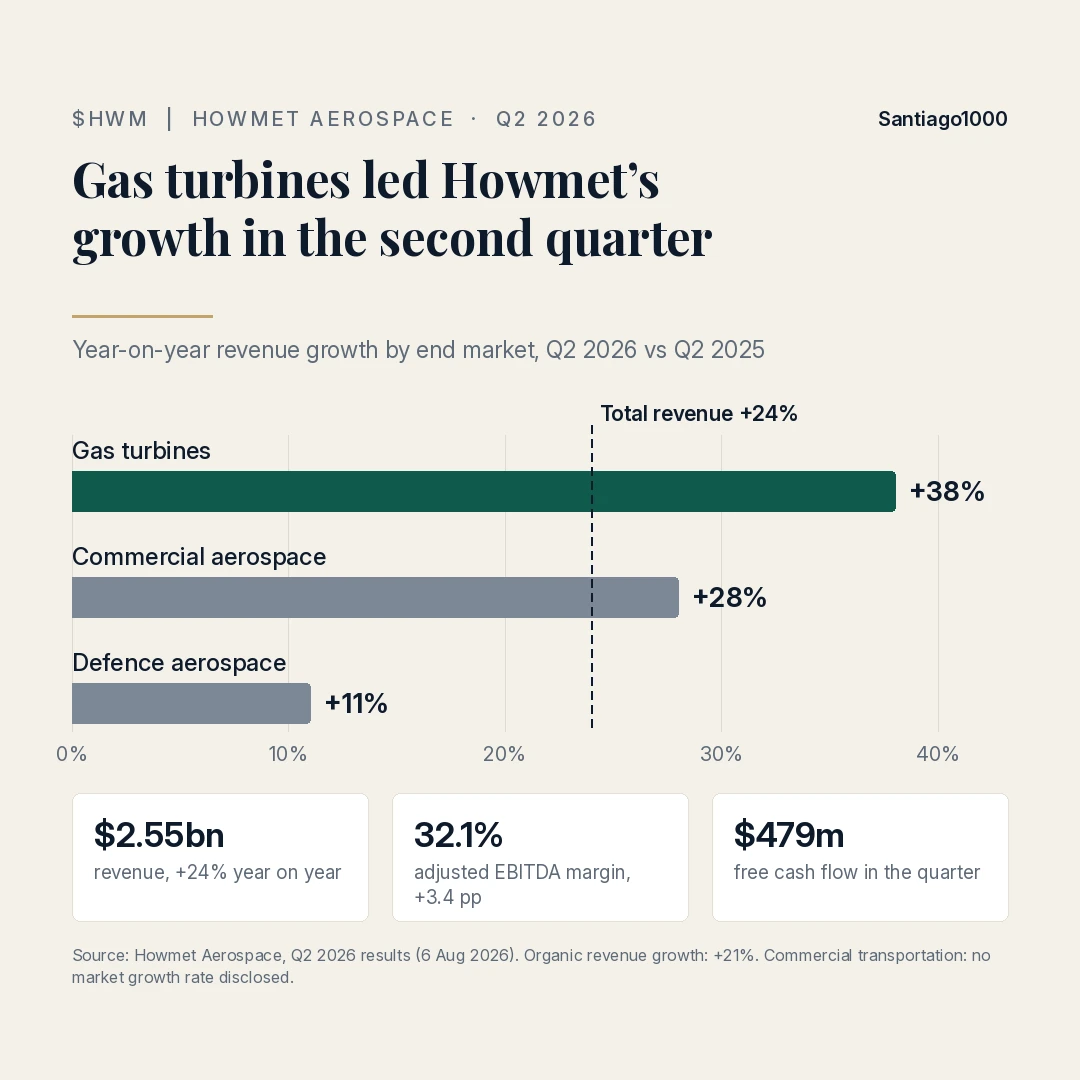
These figures establish business momentum. Assessing the shares also requires a view on expectations, future cash generation and valuation.
The $11.75 billion development investors should watch
On 8 September, GE Aerospace ($GE) announced an agreement to acquire Consolidated Precision Products (CPP), a specialist in precision castings, for $11.75 billion. CPP makes castings for aircraft engines, defence systems and industrial gas turbines — markets where Howmet also operates.
The transaction is expected to close in the second half of 2027, subject to regulatory approvals and other customary conditions.
The buyer matters as much as the deal. GE Aerospace is Howmet’s largest customer: it accounted for 14% of Howmet’s third-party sales in the first half of 2026, according to the company’s quarterly filing.
My interpretation is that the deal highlights the strategic importance of casting capacity. It could also strengthen capabilities that compete with Howmet.
There is a useful qualification. On 17 September, Reuters reported that GE’s chief financial officer, Rahul Ghai, described the acquisition as a unique situation rather than a blueprint for integrating the rest of its supply chain.
I therefore see a competitive development to monitor, not a conclusion. I would need evidence of changes in sourcing, orders or margins before concluding that Howmet’s position had deteriorated.
What this means for my portfolio
I hold both HWM and GE. Their place in the same supply chain makes it important to consider how bargaining power and economic value could shift between them.
The overlap goes further. I also hold Rolls-Royce ($RR.L) and GE Vernova ($GEV), which build aircraft engines and gas turbines — the end markets Howmet supplies. At the 23 September snapshot, these four positions represented about 15% of my portfolio, with cash included in the calculation:
- Rolls-Royce: 4.5%
- Howmet Aerospace: 3.8%
- GE Aerospace: 3.5%
- GE Vernova: 3.3%
Different tickers can share the same underlying growth driver. Aerospace and power generation broaden Howmet’s markets, but part of its growth may depend on the same infrastructure spending that supports other holdings.
My weekly scoring, last run on 18 September, places HWM in the hold range rather than the buy range. After the Q2 results, every fundamental-improvement signal I track was positive, but its 12-month price momentum sits below the median of my holdings. That is consistent with keeping the position, not with adding to it.
My assessment focuses on four things:
- Execution: whether demand becomes deliveries and cash flow.
- Economics: whether margins hold as capacity expands.
- Competition: whether customer sourcing or supplier relationships change.
- Valuation: how much future growth the share price requires.
Sustained margin pressure or the loss of important business would weaken the thesis. A lower share price would prompt a fresh assessment of value alongside those fundamentals.
What would justify continued conviction?
For me, Howmet is an example of how to investigate a theme through a specific business: start with the technology, understand the customer need, examine the economics, then decide what price and position size make sense.
I remain constructive on its specialised capabilities and its exposure to real demand. Continued conviction depends on those strengths producing durable cash flow and shareholder value as competition evolves.
The turbine blade is the detail that catches my attention. The economics determine whether it deserves a place in the portfolio.
Which deserves the next deep dive: Micron’s high-bandwidth memory or Broadcom’s optical connectivity? Let me know in the comments.
Disclosure: I hold HWM, GE, GEV, RR.L, MU and AVGO. Holdings and weights refer to my eToro portfolio on 23 September 2026, include cash and may change. This article shares my investment reasoning and is not personal investment advice. Capital is at risk.
Sources: Howmet Aerospace — thermal engineered parts, Technology and Markets Day 2026 (p. 20), Q4 and full-year 2025 results (12 February 2026), Q2 2026 results (6 August 2026) and Form 10-Q for Q2 2026; GE Aerospace — CPP acquisition announcement (8 September 2026); Reuters (17 September 2026). Portfolio weights: eToro, 23 September 2026.
Acompanha a carteira em tempo real
Todas as posições e pesos do modelo estão visíveis no meu perfil público na eToro.
Ver o perfil @Santiago1000 →Link de afiliado: se abrires conta através dele, posso receber uma comissão da eToro, sem custo para ti. Não é recomendação de investimento. O teu capital está em risco.Follow the portfolio in real time
Every position and weight in the model is visible on my public eToro profile.
View the @Santiago1000 profile →Affiliate link: if you open an account through it, I may receive a commission from eToro at no cost to you. Not investment advice. Your capital is at risk.Segui il portafoglio in tempo reale
Tutte le posizioni e i pesi del modello sono visibili sul mio profilo pubblico eToro.
Vedi il profilo @Santiago1000 →Link di affiliazione: se apri un conto tramite questo link, potrei ricevere una commissione da eToro, senza costi per te. Non è una raccomandazione di investimento. Il tuo capitale è a rischio.
