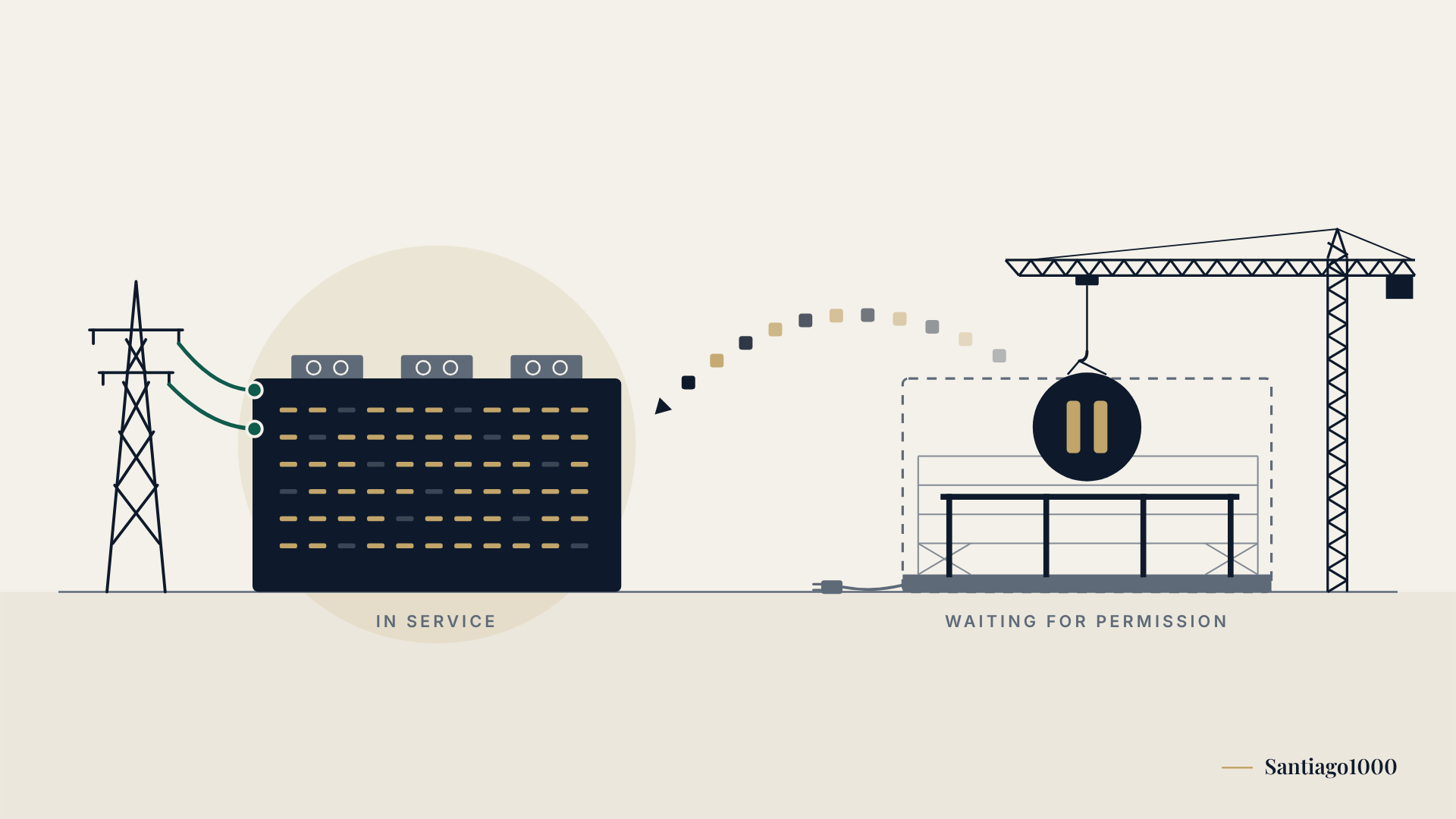
A pause on new AI data centres can make the ones already running more valuable. What the week the Nasdaq fell 10% showed me, and what I’ll be watching.
On Tuesday 17 November, Nvidia reported $115.8 billion in quarterly revenue, more than double a year earlier. By Friday 20 November, the Nasdaq Composite had lost 10% in a week, its worst week since March 2020, and the S&P 500 had fallen 8.6%.
Both numbers are true at the same time. Nvidia’s sales show how much customers have already spent. The sell-off asks a harder question: who can afford the next round?
Of everything that happened that week, the detail I keep coming back to is a proposed data centre in Ohio.
1. A pause on new AI data centres can make existing ones more valuable
About 10 gigawatts (GW) of OpenAI’s planned capacity, roughly the output of ten nuclear reactors, sits in a single project in Ohio, according to Cleanview data reported by The Wall Street Journal. Ohio’s governor-elect has called for a conditional pause on new data centres.
Nothing is settled yet. The pause would only apply to projects that haven’t started construction, and Republicans kept control of Ohio’s legislature. But it shows how much of one company’s expansion can hang on a single state’s politics.
OpenAI is the extreme case: all of its planned capacity sits in states whose governors back a pause. For Microsoft the figure is about 45%, for Amazon 42% and for Google about 20%.
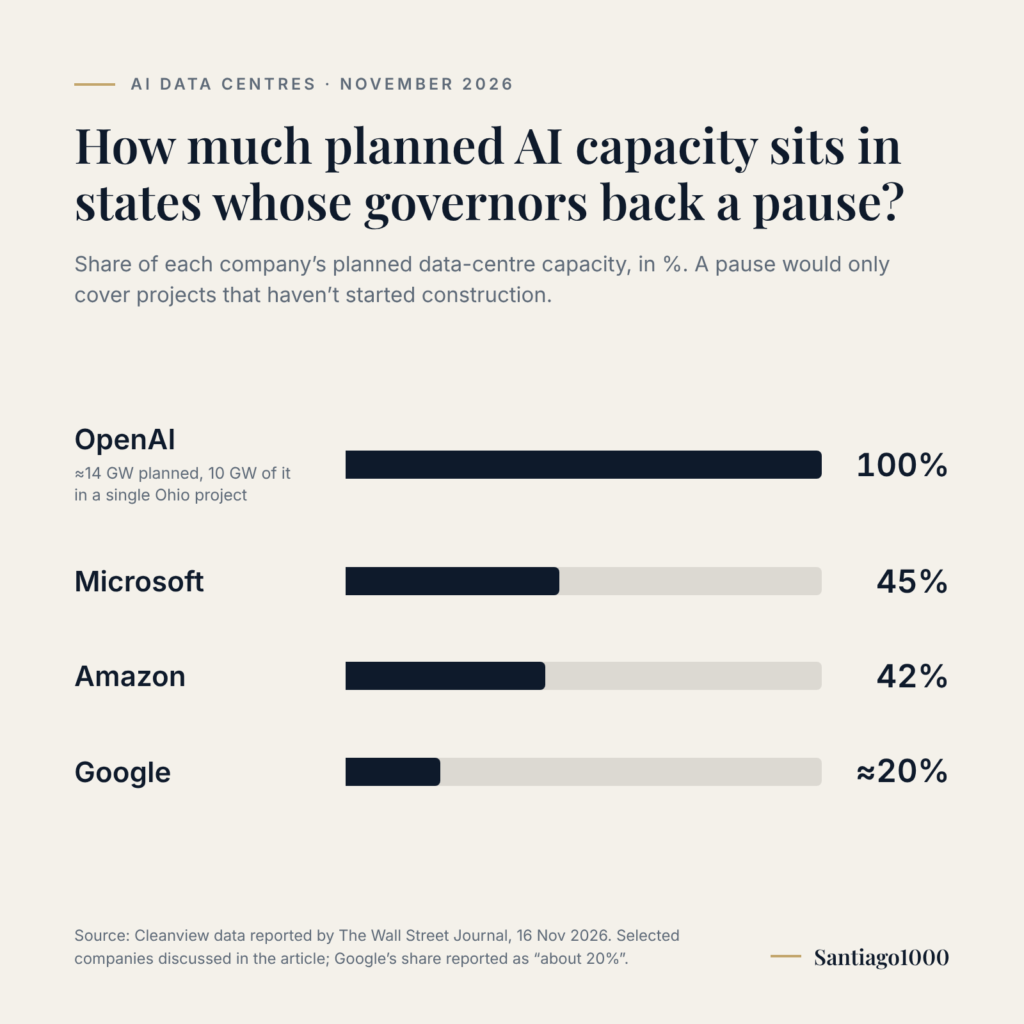
All of OpenAI’s planned capacity sits in states whose governors back a pause.
Now imagine a one-year delay. The electrical contractor waits longer for the job. The cooling supplier sees an order pushed back. But the AI developer still needs somewhere to run its models, and a cloud operator with power already connected can take that call today.
That gives Amazon, Microsoft and Google a complicated advantage: delays can make their existing facilities more valuable while holding back their own expansion. The day after the midterm elections, Amazon and Microsoft shares rose more than 6% while chip stocks fell 3%.
The distinction worth watching: how much computing power a company can rent out today, and how much still needs permission to be built.
2. Nvidia’s customers face a financing test
Nvidia expects about $130 billion in revenue this quarter, helped by an extra week in the period. Meanwhile, its finance chief, now interim CEO after Jensen Huang’s resignation, is expected to rein in the deals Nvidia used to support its own customers. UBS estimates that $50 billion or more of support could leave the market.
Ohio comes up here too. In August, Nvidia scaled back its commitment to an OpenAI data-centre lease with SB Energy in Piketon, Ohio, according to the Journal.
Nvidia’s own balance sheet shows how far that support had gone. Its stakes in other companies reached about $110 billion in late October, up from about $35 billion in January. Receivables rose by $18 billion in the quarter alone, to $81 billion.
None of this contradicts the record sales. A customer can take delivery of chips it has already ordered and still struggle to fund its next facility.
That distinction matters all the way back to the factory. TSMC has to plan wafer capacity. Micron has to commit production to high-bandwidth memory (HBM). Those decisions come months before the revenue. If developers have to raise more money from independent lenders, the first sign of a slowdown may be a smaller advance order or a later delivery date, even while chipmakers keep publishing record sales.
The question I’d ask on the next earnings calls: how much of the next expansion have customers already secured funding for?
3. AI can find a software flaw faster than a company can safely fix it
Microsoft Outlook, Apple, JPMorgan Chase, United Airlines and US air-traffic control all suffered disruptions within days of each other. As the Journal’s Greg Ip noted, many of them followed software updates meant to fix vulnerabilities identified by AI.
Finding a flaw faster is valuable. But a bank still has to test the fix and install it while people are making payments. An airline has to do the same while aircraft are in the air. As detection gets faster, the ability to roll out a fix safely, and to restore service quickly, may become the more valuable capability.
The same applies to AI infrastructure. Capacity is only worth paying for if it stays up.
Two more things from the week
On Friday, “defensive” meant two different things. That afternoon, with the S&P 500 down 3.7%, consumer staples, healthcare and energy were rising. US Treasuries rallied, and the two-year yield had its biggest weekly fall since 2024. Gold went the other way, falling 4.6% to $3,512 an ounce, a 52-week low. Anyone treating gold and government bonds as interchangeable protection got two very different results on the same day.
Cheaper diesel tells us surprisingly little about refiners’ profits. US diesel fell back below $6 a gallon in mid-November, from a record of about $6.52 in September. The International Energy Agency (IEA) expects the oil market to return to surplus this quarter, and at their summit in Shenzhen on 19 November, the US, China and Russia said they plan to increase the supply of refined products. Yet US diesel stocks are still near their lowest level since 2013. For a haulier, cheaper diesel is good news. For a refiner such as Valero, it depends on both sides of the barrel: if crude falls faster than diesel, margins can widen even as drivers pay less; if extra supply pushes diesel down faster, they narrow. The figure to watch in the next results is the refining margin per barrel, not the price at the pump.
What I’ll be watching
I remain optimistic about the demand for computing power. What this week sharpened for me is the difference between wanting more capacity and being able to deliver it profitably. In the next round of results, I’ll be looking for three things:
- sites that have actually secured power;
- customers that have secured financing;
- cloud revenue earned from capacity already in service.
Those figures will tell us more about the next stage of the AI build-out than another headline about how many billions someone intends to spend.
And in the Santiago1000 portfolio?
In my portfolio, the argument of this article cuts both ways. At the close on Friday 20 November, by market value and including cash, the three cloud operators mentioned here (Microsoft, Amazon and Alphabet) made up 12.9% of the portfolio. The chip companies (Nvidia, TSMC, Micron and Broadcom) added 16.4%, and the companies that build and equip data centres (Vertiv, Comfort Systems, Celestica and GE Vernova) another 10.8%. That’s about 40% in direct positions, before counting my indirect exposure through the ETFs I hold (VOO, QQQ and RSPT).
Part of that exposure could gain if pauses make capacity that’s already running scarcer. Another part depends on customers being able to finance the next sites. I’ll be checking these three signals as results come in. If they justify a change to the portfolio, I’ll explain it here, with the reasoning.
If you’d like to see the method and the numbers, the Results and Risk page shows return, risk and portfolio composition, updated every month. You can also view my profile on eToro to check the stats, risk score and holdings, and decide whether this approach suits you.
Disclosure: I hold positions in Nvidia, TSMC, Micron, Broadcom, Microsoft, Amazon, Alphabet, Apple, JPMorgan, Valero, Vertiv, Comfort Systems, Celestica and GE Vernova, and in the VOO, QQQ and RSPT ETFs. I’m a Popular Investor on eToro, and this article contains an eToro Partners affiliate link. This is personal analysis, not investment advice. Investing and copy trading involve risk, including loss of capital, and past performance is not a reliable indicator of future results.
Sources
- Nvidia, Q3 fiscal 2027 results, 17 Nov 2026
- The Wall Street Journal, Anthropic’s IPO turmoil caps $4 trillion AI wipeout, 21 Nov 2026
- The Wall Street Journal, Nasdaq turns red for the year, 20 Nov 2026
- The Wall Street Journal, The (few) stocks defying the tech selloff, 20 Nov 2026
- The Wall Street Journal, Big Tech needs to spread its bets on data centers, 16 Nov 2026
- The Wall Street Journal, How the data center backlash could play into the hands of Big Tech, 5 Nov 2026
- The Wall Street Journal, Nvidia reports faster growth, says Jensen Huang won’t return as CEO, 17 Nov 2026
- The Wall Street Journal, Nvidia’s days as an open checkbook for the AI economy are numbered, 15 Nov 2026
- The Wall Street Journal, Four ways techruptions may shape the economy, 19 Nov 2026
- Reuters, US diesel below $6 a gallon at 2-month low, 15 Nov 2026
- The Wall Street Journal, Global oil market expected to return to surplus, IEA says, 13 Nov 2026
- The Wall Street Journal, Trump, Xi, Putin end historic summit, 19 Nov 2026
- Portfolio weights: my eToro account, market value including cash, at the close on 20 Nov 2026
Acompanha a carteira em tempo real
Todas as posições e pesos do modelo estão visíveis no meu perfil público na eToro.
Ver o perfil @Santiago1000 →Link de afiliado: se abrires conta através dele, posso receber uma comissão da eToro, sem custo para ti. Não é recomendação de investimento. O teu capital está em risco.Follow the portfolio in real time
Every position and weight in the model is visible on my public eToro profile.
View the @Santiago1000 profile →Affiliate link: if you open an account through it, I may receive a commission from eToro at no cost to you. Not investment advice. Your capital is at risk.Segui il portafoglio in tempo reale
Tutte le posizioni e i pesi del modello sono visibili sul mio profilo pubblico eToro.
Vedi il profilo @Santiago1000 →Link di affiliazione: se apri un conto tramite questo link, potrei ricevere una commissione da eToro, senza costi per te. Non è una raccomandazione di investimento. Il tuo capitale è a rischio.
