A year ago, Google Cloud earned about $24 of operating profit for every $100 of sales. In the third quarter of 2026, it earned $36. Along the way, revenue more than doubled. It is hard to ask for more from a growing business. Yet anyone who bought Alphabet shares to ride the growth of artificial intelligence now faces a less obvious sum. In the same quarter, the group as a whole spent more on buildings and equipment than its operations brought in. The market noticed: Alphabet shares fell by about 19% in October.
These two numbers measure different things, and much of the share’s value depends on the gap between them. Cloud’s profit shows what Alphabet already earns by selling computing capacity. Free cash flow shows how much money is left after paying, among other things, for the servers that will make the next sale possible.
Search still dominates, but Cloud already earns $11 billion in operating profit
Google Search and related services generated $63.4 billion in the third quarter, 12% more than a year earlier. It is still a business with more than twice Google Cloud’s revenue. What has changed is the scale of the second business. In one year, Cloud’s revenue rose from $15.2 billion to $30.7 billion. Operating profit climbed from $3.6 billion to $11.1 billion. Alphabet results, Q3 2026.
For every extra dollar of revenue compared with the same quarter a year earlier, Cloud generated about 48 cents of additional operating profit. That helps justify building capacity. What remains to be seen is whether profitability holds as more equipment comes into service.
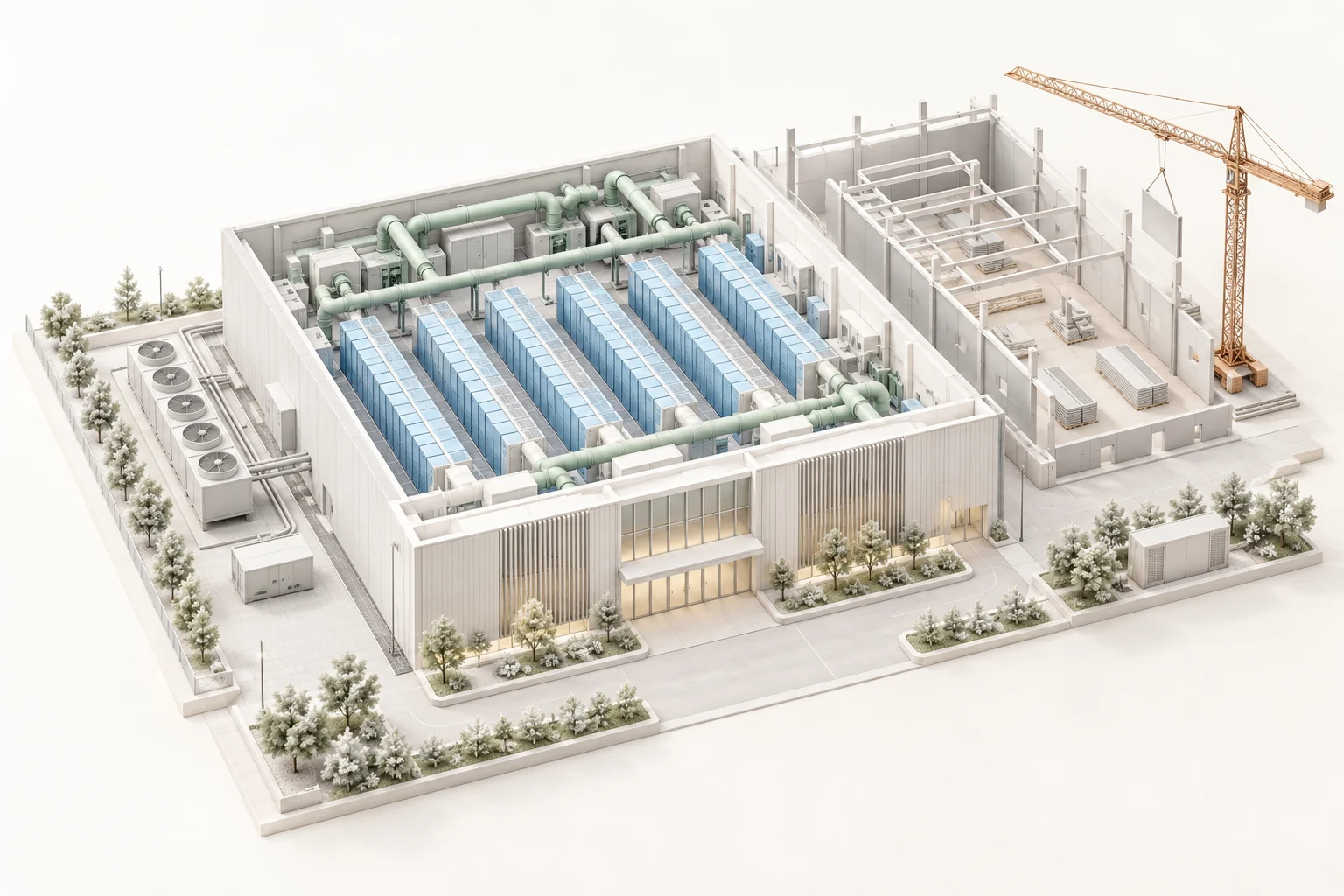
A data centre starts consuming capital before it serves its first customer. Conceptual illustration generated with AI.
What happened to Alphabet’s cash?
A server enters the accounts in two stages. When the company pays for it, the cash leaves the bank. In the income statement, the cost of the equipment is spread over the years it is expected to be used, through depreciation. At Alphabet, that bill has already started to arrive: quarterly depreciation rose from $5.6 billion to $8.4 billion in a year. During a rapid expansion, profit can grow while the cash available for dividends, share buybacks or new ventures shrinks.
| $ billion | Q1 2026 | Q2 2026 | Q3 2026 |
|---|---|---|---|
| Cash from operations | 45.8 | 39.1 | 42.3 |
| Capital expenditure | 35.7 | 44.9 | 51.4 |
| Free cash flow | 10.1 | −5.9 | −9.1 |
Alphabet, consolidated accounts. Figures rounded individually.
In six months, quarterly capital expenditure rose from $35.7 billion to $51.4 billion, while cash from operations went from $45.8 billion to $42.3 billion. These figures cover the whole of Alphabet. The company still generated $19.7 billion of free cash flow in the twelve months to September, but the last two quarters ate into the surplus built up earlier. Alphabet results, Q3 2026.
Who is paying for the expansion?
In 2025, Alphabet was still returning cash to shareholders through buybacks: $39.8 billion in the first nine months of the year. In the same nine months of 2026, buybacks were zero. The company went the other way. It sold $42.9 billion of new shares, issued $19.1 billion of mandatory convertible preferred stock and raised $85.2 billion of debt. The diluted share count rose by 1.4% in a year.
The balance sheet can take it: at the end of September, Alphabet held $265.1 billion in cash and marketable securities, against $125.1 billion of long-term debt. But, for now, the answer to the question in the headline is uncomfortable. Dividends continue, yet it is the shareholder who is helping to fund the expansion rather than collecting the surplus. Alphabet results, Q3 2026.
Are Alphabet shares really trading at 14.6 times earnings?
At the close on 30 October, Alphabet’s Class A shares (GOOGL) traded at $279.84. On earnings over the last four quarters, $19.16 per share, that was a multiple of 14.6 times. The Class C shares (GOOG), which I hold in the portfolio, have the same earnings per share and trade at almost the same price. For a company as profitable as Google, that price stands out. But shareholders are also buying a portfolio of stakes in other companies, whose swings in value flow through reported profit.
In the second quarter, $6.26 of the $9.11 of diluted earnings per share came from those stakes. In the third, they took away $0.55. Over four quarters, $8.21 of the $19.16 of earnings per share came from the net after-tax effect of those swings. Alphabet results, Q2 2026 and Q3 2026.
Strip out that effect alone and $10.95 per share remains. At the same price, the multiple rises to 25.6 times. This is an illustrative calculation based on past results. The stakes have value of their own, but it would be a stretch to count on recent gains repeating every year to justify the entry price. To rebuild the four-quarter calculation, see also Q4 2025 and Q1 2026.
What would have to happen for the AI bet to pay off?
At the end of September, Google Cloud had about $561 billion in customer contracts not yet recognised as revenue. Three months earlier the figure was $514 billion (The Motley Fool). This is the strongest argument for the expansion: there is contracted demand for the capacity Alphabet is installing. The unknown is how much it will cost to deliver those contracts and what margin will be left after providing the service. Alphabet quarterly report.
The best-case scenario does not even need sales to double again. It is enough for customers to use more hours of the servers already installed. Alphabet can then bill more on equipment it has already paid for, and free cash flow can recover even if percentage revenue growth slows. Cloud’s operating margin gives investors a first clue about that utilisation.
There is also a less comfortable scenario. If serving each new wave of customers requires another generation of chips, more power and new data centres, Cloud’s profit could keep growing without much more cash left at the end of the year. If demand slows in the meantime, the company will keep booking depreciation on equipment it has already bought. And investment has not peaked yet: Alphabet is sticking to its forecast of $195–205 billion of capital expenditure in 2026, which implies $63–73 billion in the fourth quarter alone, and management has flagged another significant increase in 2027 (earnings call, FourWeekMBA summary).
My reading is positive on the business and more demanding on the price. Search keeps growing and Cloud has already shown it can sell more at higher margins. The shares’ apparent discount, however, rests on financial gains that are hard to repeat. In the next results, I will look first at Cloud’s margin and then at the gap between the cash Alphabet generates and what it spends on equipment. If the margin holds and that gap turns positive again for several quarters, the case for the shares gets stronger.
And in the Santiago1000 portfolio?
Alphabet stays in the portfolio. After these results, it lost strength in my selection process, mainly on price momentum and cash generation, while the quality of the business remains high. I will not add to the position until free cash flow turns positive again. The weight will be reviewed in the coming weekly readings, under the same rules I apply to the rest of the portfolio. Up-to-date positions and weights are on my public eToro profile (affiliate link).
Legal notice and disclosure of interests
This article reflects the author’s opinion as of 1 November 2026 and is for information only. It is not personalised financial advice or a recommendation to buy or sell. Investing in shares involves the risk of losing capital, and past performance does not guarantee future results. At the time of writing, the author held Alphabet Class C shares (GOOG) in the Santiago1000 portfolio. The author takes part in eToro’s Popular Investor programme, which may pay him based on the investors who copy him, and this site contains eToro affiliate links. Disclosures and risk information.
Acompanha a carteira em tempo real
Todas as posições e pesos do modelo estão visíveis no meu perfil público na eToro.
Ver o perfil @Santiago1000 →Link de afiliado: se abrires conta através dele, posso receber uma comissão da eToro, sem custo para ti. Não é recomendação de investimento. O teu capital está em risco.Follow the portfolio in real time
Every position and weight in the model is visible on my public eToro profile.
View the @Santiago1000 profile →Affiliate link: if you open an account through it, I may receive a commission from eToro at no cost to you. Not investment advice. Your capital is at risk.Segui il portafoglio in tempo reale
Tutte le posizioni e i pesi del modello sono visibili sul mio profilo pubblico eToro.
Vedi il profilo @Santiago1000 →Link di affiliazione: se apri un conto tramite questo link, potrei ricevere una commissione da eToro, senza costi per te. Non è una raccomandazione di investimento. Il tuo capitale è a rischio.
